MRCCC’s 250th General Meeting
250 and still going strong!
MRCCC, the Mary River Catchment Coordinating Committee, celebrated a milestone recently, its 250th general meeting, and it did it in style.
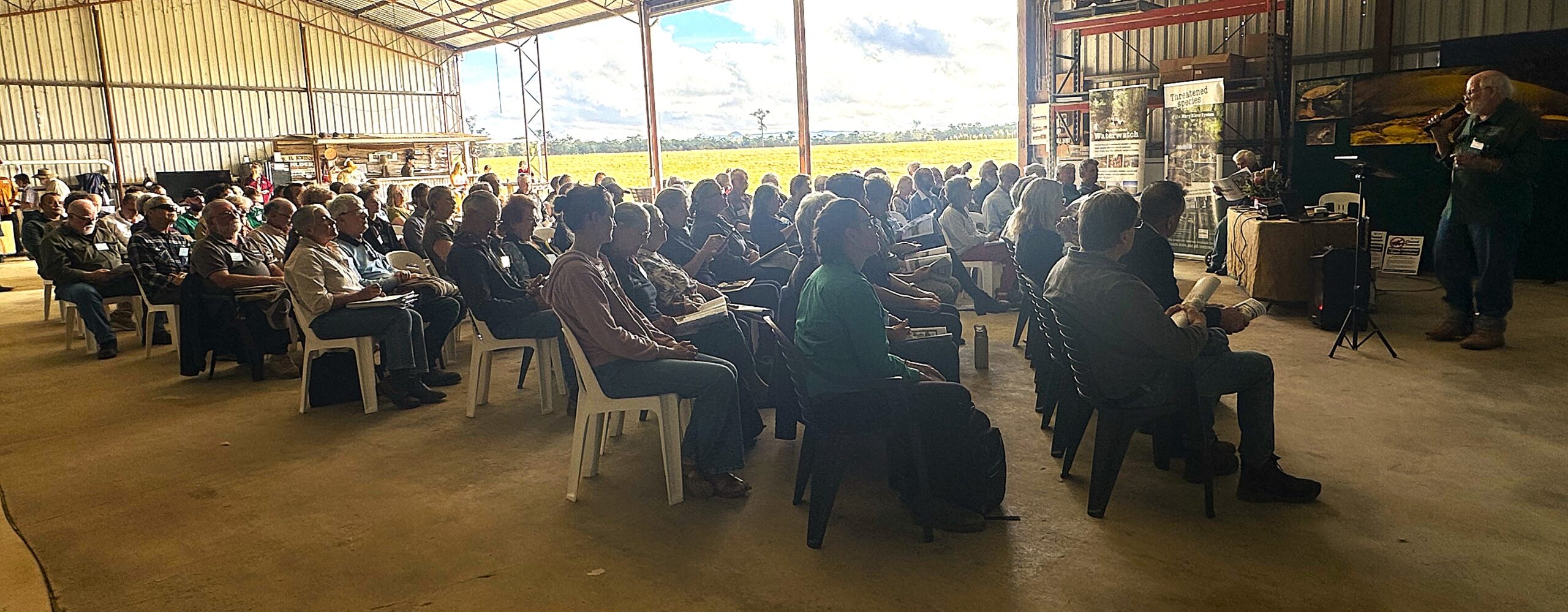
With over a hundred people attending, the event was held at Darren Knowles’ Hinternoosa Hatchery near Cooroy, the location, in recent years, for the breeding program of Mary River cod fingerlings for conservation stocking into waterways in the Mary River catchment.
The meeting included a presentation by MRCCC staff, both past and present, which traced the activities of the organisation over the past 30+ years.
The opening acknowledgement went much further back than this though, to recognise and respect the long-term custodianship of the Jinibara, Kabi, Kabi, Wakka Wakka and Butchulla peoples, of a river that wound through and connected their territories and their cultures.
A special guest at the meeting was Marty Hunt, state member for Nicklin, representing Environment Minister Andrew Powell. Marty’s present electorate covers a good deal of the upper Mary catchment but under the electoral re-distribution as currently proposed, the new electorate (tentatively called Nambour) would cover a much greater area, including areas to the south of Gympie.
MRCCC had its beginnings as a catchment planning group consisting of influential Gympie business owners led by Guenter Kath. Guenter recognised the potential benefits of Integrated Catchment Management (ICM) being offered by the state government in the early nineties, and lobbied the government at the time for the Mary to be included as one of five trial pilots of the scheme.
Greater awareness of the river and catchment wasn’t limited to Gympie though. Two years after Baroon Pocket dam had been built on Obi Obi Creek, Maroochy Shire Chairman Fred Murray had called for another dam on the Mary, predicting that unless that eventuated, “the Sunshine Coast would run out of water by the year 2000”.
The resultant state government study into potential dam sites on the Mary proved to be a rallying call in the upper catchment, with Maleny high school teacher Peter Oliver organising the first Mary river Congress in 1993, bringing together more than 200 people from all parts of the catchment, and seeing for the first time, a map of the whole catchment showing the detail and the connectedness, of the region in which they lived.
The ICM process began as a series of public meetings which identified not only issues wider than potential damming (several recent floods had led to serious bank erosion for example) but also significant stakeholder groups in the catchment.
Thus the early make-up of MRCCC was a committee of delegates representing those interest sector groups, all led by a government appointed coordinator, Steve Kelly.
There was much speculation and reservation in those early days, as to how a group with such diverse interest sectors would function cohesively. Reflecting at the 100th meeting back in 2005, Steve Kelly had said there were times when he wondered if MRCCC would get to meeting 4, let alone 100.
And yet, the MRCCC has not only survived but prospered, recognising the common interests we share, rather than the things which have the potential to divide us.
Over the years there have been some changes. Early meetings often focussed on riverbank collapse, generally in economic primary production terms. Only later did scientific research recognise that those bank collapses were the major source of sediment reaching the southern part of the Great Barrier Reef. Reef programs have increasingly featured both best management practice and dairy effluent work as well as riverbank restoration. These works have enabled the MRCCC to progressively appoint more staff to bring government funding to a practical landholder level.
Similarly, both action and research has focussed on the Mary’s threatened species. While MRCCC isn’t an environment group per se, recognising that our catchment provides habitat for a number of species on the brink of extinction, any focus we have on long-term sustainable land use has to consider these species as significant stakeholders, their very existence being on the line.
MRCCC’s early existence had been somewhat nomadic, being based over the years in a number of temporary premises in Gympie. Gympie was identified as a fairly central location in a catchment that stretches from headwaters around Maleny to a river mouth downstream of Maryborough.
In 2014, thanks to some generous donors, MRCCC was able to purchase its own premises, at Stewart Terrace in Gympie, and establish purpose-built premises for its growing staff. While suitable for small meetings, the larger general meetings held every six weeks, continue to be located in venues throughout the catchment.
To mark the 250th general meeting, an impressive booklet of achievements over the years is available to download.
As well as looking back over the past, the meeting included two other presentations. The first was on another icon of the catchment, the macadamia, or Bauple, nut. Tina Raveneau, newly appointed project officer for Wild Macadamia Conservation, now partnering with MRCCC, explained the scope of her new project.
Hinternoosa Hatchery owner and Manager Darren Knowles explained to a fascinated audience the intricacies of successfully rearing Mary River cod fingerlings, acknowledging many of the learnings about the fish’s biology having been made by hatchery founder Gerry Cook.
MRCCC is grateful for the ongoing interest and involvement of its many partners, the wider community and its landholders, many of whom were there on the day to look back over the organisation’s life and times, its achievements and challenges.